Erfahre, warum vertrauenswürdige Echtzeitdaten für die Skalierung von KI und die Erzielung von Business Value entscheidend sind | Mehr Infos
What Is a Cloud Migration? A Guide to Avoiding the Lift-and-Shift Trap
Cloud migration is the process of moving applications, data, and IT workloads from on-premises infrastructure into a cloud environment. The migration itself can take several forms from simple lift-and-shift rehosting to more advanced refactoring or rearchitecting with real-time technologies like Apache Kafka®.
This guide will walk you through common cloud migration strategies in use today and how data streaming can help you balance speed, risk, cost, and long-term modernization goals.


What Are Some Common Cloud Migration Strategies to Consider?
A cloud migration is often an essential step forward in enabling data-driven decision-making and more agile data architectures. Businesses implementing real-time operations are often motivated by the elasticity, lower operational overhead, and access to modern capabilities available in cloud environments.
Once an organization decides to move to the cloud, the next step is choosing how to approach the migration. Most teams align with one of three commonly used strategies—lift and shift, re-platforming, and re-architecting migrations—each offering a different balance of effort, cost, and long-term modernization.
Each offering a different balance of effort, cost, and long-term modernization, allowing organizations to choose the path that best aligns with their technical and business goals.
Lift and Shift (Rehost) Migrations
This is the most straightforward approach: moving an existing application or workload to the cloud with minimal adjustments.
-
Speed: Quickest way to migrate
-
Changes Involved: Little to none; the architecture largely remains as is
-
Ideal Use Cases: Workloads that need to move fast or systems that don’t require immediate redesign
Re-Platforming Migrations
Here, the core application stays intact, but a few targeted improvements are introduced during the migration.
-
Typical Enhancements: Switching to managed databases, adding autoscaling, or adopting elastic storage
-
Purpose: Gain efficiency and operational benefits without rebuilding the system
-
Ideal Use Cases: Teams looking for meaningful improvements without a full architectural overhaul
Re-Architecting (Cloud-Native) Migrations
For organizations aiming to fully embrace cloud capabilities, re-architecting offers the deepest level of modernization.
-
Modern Patterns: Microservice applications, containers, serverless functions, real-time data processing
-
Result: Greater scalability, resilience, and long-term agility
- Ideal Use Cases: Core business systems that need to evolve alongside digital transformation initiatives
When Should You Choose a Lift and Shift Migration Strategy?
A lift and shift migration is the process of moving applications, virtual machines, or data to the cloud largely “as is”—making minimal configuration or code changes and preserving the existing architecture while changing only the underlying infrastructure. This approach is a practical choice for organizations that want to and that need to:
-
Move workloads to the cloud on short timelines without introducing immediate architectural risk
-
Quickly lower on-premises infrastructure and maintenance costs while avoiding major refactoring during the initial migration phase
-
Transition legacy systems that are not yet ready for redesign
By prioritizing speed and simplicity, teams can establish a cloud presence and reduce reliance on on-premises infrastructure early in the migration journey. That's why lift-and-shift migrations are often used to accelerate cloud adoption in the first phase of a modernization initiative. Because workloads are not optimized for cloud-native services, the full benefits of scalability, resilience, and cost efficiency are realized later through re-platforming or re-architecting.
For data-heavy workloads, maintaining continuity during the move is especially important. Data synchronization techniques such as change data capture (CDC) enable low- or near-zero downtime during a lift and shift migration.
Weighing the Benefits vs. Challenges of Lift and Shift Migrations
The benefits of the lift-and-shift approach are most visible early in the migration journey, when speed and simplicity are often the highest priorities. But this approach also comes with limitations that teams should plan for early. Because workloads are migrated largely unchanged, many of the issues present in on-premises environments can carry over into the cloud.
Summary of Benefits vs. Challenges of Lift and Shift Cloud Migrations
|
Benefits |
Challenges |
|
|
Time Savings |
Faster time to cloud: Lift and shift is the quickest way to migrate, allowing teams to move workloads with minimal disruption to applications or users. |
Limited cloud efficiency: Lifted workloads typically don’t take advantage of cloud-native features such as autoscaling, managed services, or event-driven architectures, resulting in additional operational burden once in the cloud. |
|
Architectural Risks |
Lower migration risk: Since the architecture remains largely unchanged, teams avoid the uncertainty that often comes with large-scale redesigns. |
Technical debt remains: Since the existing architecture is preserved, legacy design decisions and operational complexity are often moved rather than resolved. |
|
Costs |
Reduced infrastructure costs: Moving workloads off on-premises hardware helps eliminate data center maintenance, hardware refresh cycles, and associated operational expenses. |
Hidden cost risks: Applications designed for fixed on-prem infrastructure may consume cloud resources inefficiently, leading to higher-than-expected compute and storage costs. |
|
Scope |
Simpler project scope: Compared to re-platforming or re-architecting, lift and shift requires less upfront planning and fewer cross-team dependencies. |
Data consistency challenges: Migrating mission-critical databases can introduce synchronization and downtime risks, especially when applications must remain live during the transition. |
|
Cloud-Native Capabilities |
Immediate access to cloud scalability: Even without redesigning applications, workloads can benefit from the cloud’s elastic infrastructure and improved availability. |
Modernization is still required: To fully benefit from the cloud, organizations usually need a follow-on phase focused on re-platforming or re-architecting. |
Taken together, these factors make lift and shift an effective entry point into the cloud providing quick wins while laying the groundwork for deeper modernization in later phases. That’s when teams begin refactoring applications, decoupling services, and adopting cloud-native data and streaming patterns and where platforms like Confluent can help bridge the gap between rapid migration, streaming integration, and long-term cloud optimization.
How Can You Use Data Streaming to Successfully Lift and Shift to the Cloud?
Many of the limitations of lift and shift especially around unplanned downtime, data consistency, and sequencing or ordering guarantees come down to how data is moved. Streaming data with Kafka enables zero-downtime lift and shift migration by keeping on-premises and cloud environments continuously synchronized.
With data streaming in place, teams can:
-
Replicate data in real time between source and target systems during migration
-
Validate cloud environments safely using live, up-to-date datasets
-
Avoid hard cutovers that introduce downtime, data loss, or prolonged freeze windows
-
Introduce event-driven integrations early, before and after workloads move to the cloud
Instead of treating migration as a single, high-risk event, streaming ensures that lifting and shifting workloads into the cloud can be a controlled, incremental process.
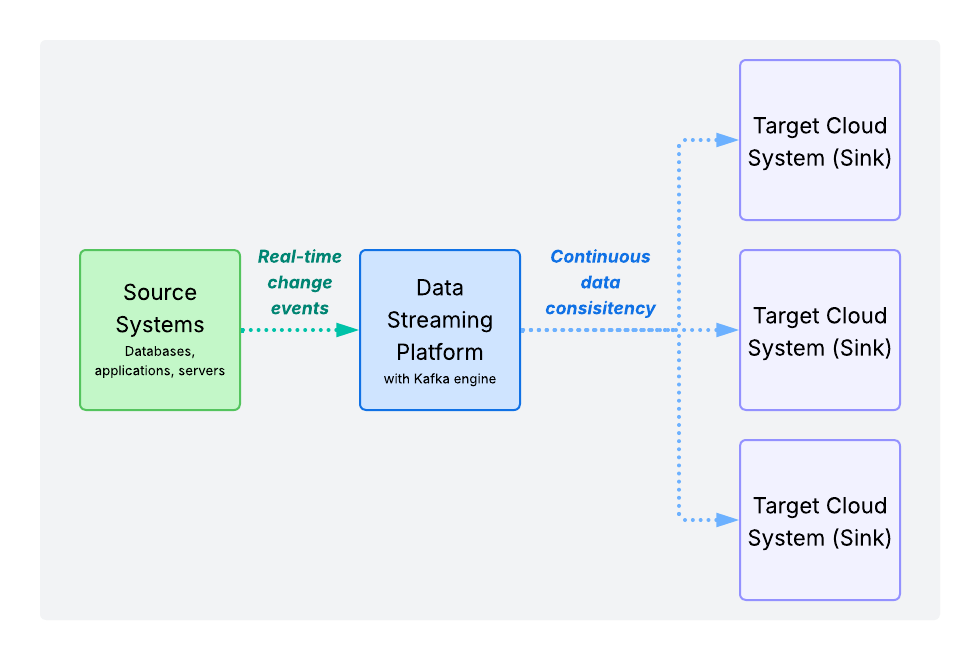
By establishing streaming during the initial lift and shift phase, organizations not only reduce risk they also lay the foundation for cloud-native architectures and real-time systems that follow. For teams looking to operationalize this at scale, Confluent Cloud provides a fully managed way to run Kafka and streaming pipelines without managing infrastructure.
Beyond Lift and Shift: When Are Re-Platforming and/or Cloud-Native Modernization Worth the Effort?
Lift-and-shift migrations should be treated as a starting point, not the end goal. Taking this approach at the start helps organizations move quickly to the cloud, but real value comes after the migration is complete.
Once workloads are running in the cloud, teams can focus on the next phase: modernization without the pressure of a tight migration deadline. This phase is about improving how systems are built and how data moves and typically includes:
-
Adopting serverless and elastic streaming architectures
-
Moving to event-driven microservices instead of tightly coupled systems
-
Replacing batch processing with real-time data pipelines with
-
Using cloud-native databases and storage designed for scale and reliability
Streaming plays a central role in this transition. It decouples systems, allowing legacy applications and new cloud-native services to run side by side. Teams can modernize gradually, one component at a time, instead of rewriting everything at once. Adopting serverless Kafka through platforms like Confluent Cloud can be a catalyst for these modernization efforts.
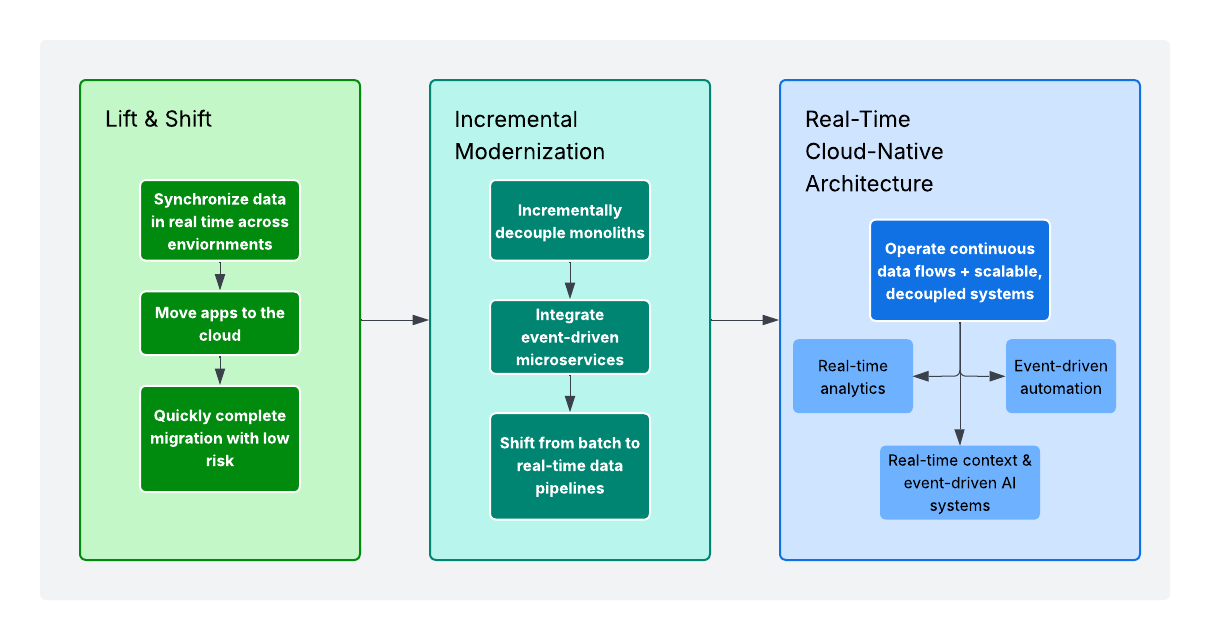
By shifting from batch-based processing to continuous data flows, organizations build modern data architectures that are more responsive, scalable, and resilient. Platforms like Confluent make this possible by supporting both lift-and-shift migration today and incremental modernization to real-time, cloud-native systems tomorrow—turning migration into an ongoing evolution rather than a one-time project.
5 Data-Centric Best Practices for Your Next Cloud Migration
A successful cloud migration is rarely about a single decision. It’s a sequence of deliberate steps that balance speed, stability, and long-term modernization. Here are five best practices to help your team move with confidence as you modernize and migrate your data architectures while keeping future growth in mind.
1. Assess Data Workloads Early
Start by understanding what you’re migrating. Some applications can be rehosted quickly, while others may benefit from refactoring or re-architecting once they reach the cloud.
2. Choose the Right Migration Strategy
Evaluate lift and shift versus modernization based on business priorities such as timeline, cost, and long-term architectural goals. In many cases, organizations use a mix of strategies rather than a single approach.
3. Leverage Data Streaming for Zero Downtime
Use real-time data streaming to keep on-prem and cloud systems continuously synchronized. This reduces cutover risk and allows migrations to happen incrementally instead of all at once.
4. Modernize Incrementally
Avoid large, disruptive rewrites. Begin with critical services, data platforms, or integration points, and expand modernization efforts as teams gain confidence and experience.
5. Monitor and Optimize After Migration
Once workloads are live in the cloud, continuous monitoring is essential. Track performance, reliability, and cost, and refine configurations over time to fully realize cloud benefits.
How Are Organizations Using Confluent for Cloud Migrations Today?
As organizations move from initial migration to long-term modernization, data becomes the most critical dependency to get right. Using Confluent’s cloud-native Kafka service as a real-time data plane, organizations like Michelin, Wix, Rodan + Fields, and DKV Mobility have implemented complex migrations by streaming changes as they happen, rather than relying on disruptive batch cutovers.
Confluent offers real-time data streaming that gives teams a reliable way to move, synchronize, and evolve data across on-premises and cloud environments during cloud migrations. Whether the goal is rapid rehosting, re-platforming, or full cloud-native transformation, Confluent provides a consistent streaming foundation at every stage.
Key capabilities include:
-
Fully managed, cloud-native Kafka through Confluent Cloud, removing the operational burden of running streaming infrastructure
-
A broad ecosystem of pre-built connectors for integration across cloud databases, SaaS applications, and object storage systems
-
Built-in governance and security, including schema management and access controls, to keep data reliable and compliant across environments
-
Elastic scaling, global availability, and enterprise SLAs designed for mission-critical workloads
- Real-time replication between on-premises and cloud environments to support zero-downtime migrationBy combining streaming, governance, and operational simplicity, Confluent helps organizations migrate with confidence while laying down a durable data backbone for cloud-native and real-time architectures.
By combining event streaming, integration, governance, and operational simplicity, Confluent helps organizations migrate with confidence while laying down a durable data backbone for cloud-native and real-time architectures.
Cloud Migrations – FAQs
What is cloud migration vs. a lift-and-shift migration?
A cloud migration is the process of moving applications, data, or workloads from one environment to another. Organizations typically migrate to improve scalability, reduce operational overhead, and modernize their systems, and the way that they approach that migration can be wholesale (i.e., moving the entire application or workload as-is or moving it incrementally). A lift-and-shift migration takes an “as-is” approach, so applications or data are moved to the cloud with minimal or no changes to their existing architecture. It is often used as the first step in a broader modernization journey.
What are the pros and cons of lift-and-shift migration?
The main advantages of lift and shift are speed, lower complexity, and reduced upfront effort. However, because the architecture remains unchanged, technical debt can persist, cloud resources may not be fully optimized, and follow-on modernization is usually required.
How does Kafka help with cloud migration?
Kafka enables real-time streaming of data between on-premises and cloud environments. This allows systems to stay continuously synchronized, supports near zero-downtime migrations, and enables teams to migrate workloads incrementally rather than through risky cutovers.
Does Confluent support lift-and-shift migrations?
Yes, customers use Confluent’s data streaming platform for cloud migrations, whether complete, lift-and-shift use cases or incremental replatforming or re-architecting approaches. Through serverless Kafka, prebuilt connectors, governance features, and real-time replication, Confluent helps teams migrate reliably while preparing for cloud-native modernization.